Hologram Labels on Sheets or Rolls: Compare Usable Output
The roll quote and sheet quote contain the same number of seals. The packing team still needs to know how many can be picked, placed and accounted for without improvised cutting or unrecorded rejects.
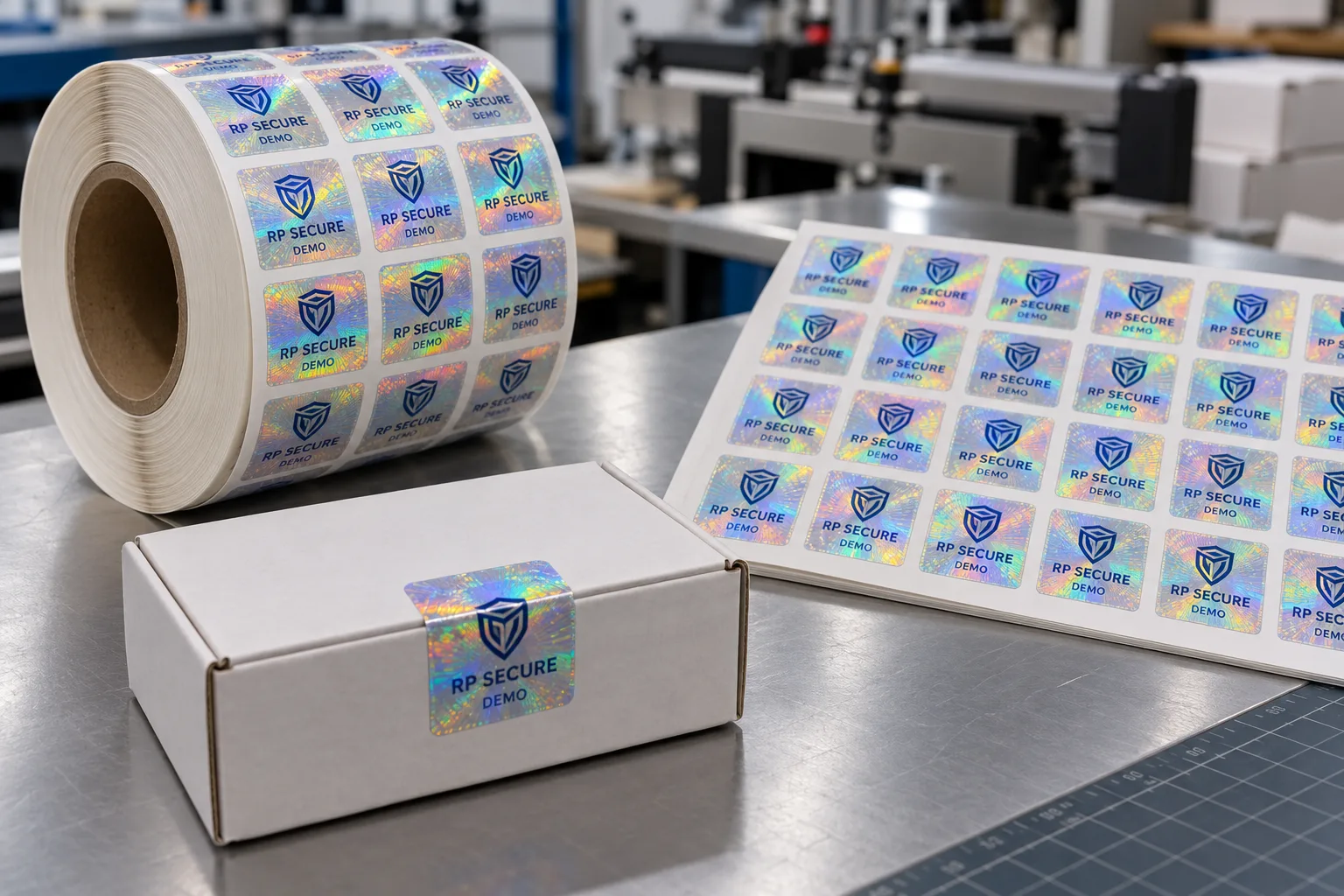
Imagine a buyer choosing a format from an attractive hologram reference. A team sealing prototype cartons by hand and an automatic packing line may need different delivery formats even when the artwork is identical. Start by asking who will apply the labels and how the station handles them.
Reconcile the trial from supplied seals to accepted packs
Start with one approved artwork and the same intended package. If the converter proposes different liners or spacing for sheets and rolls, identify those changes. The trial compares those delivered formats, not an abstract choice between two ways of storing the same sticker. Ask the actual packing team to perform the pick-and-place sequence rather than approving it from the sales sample.
Record supplied labels, labels attempted, accepted applied packs, damaged or rejected labels, and remaining usable labels. Keep samples held for inspection in their own category. Counts should reconcile without making rejects disappear into an assumed allowance. This is particularly important if the project has controlled serial numbers; a simple unnumbered count sheet is not a substitute for a serial reconciliation process.
For hand work, observe whether the operator can lift the edge without touching the adhesive or bending the seal, and whether the last sheet rows are as usable as the first. For rolls, include the actual dispenser or applicator and an ordinary stop and restart. A format that creates more handling may still be acceptable for a small mixed-design kit, but that choice should be visible.
Sheets deserve to win when the packing station benefits from their organization and meets the same application and count requirements. Rolls deserve to win when the installed route handles them reliably and the order mix supports that setup. Neither a lower nominal unit price nor a larger roll establishes usable output on its own.
The worked flow sheet provides the accounting categories and the disposition of a held sample without invented efficiency percentages. Add your real trial counts and staff observations before approving the format. Send RP the package, artwork mix, application station and proposed quantity per sheet or roll, then agree what the delivered usable-count instruction means. Do not leave the team to convert one format into the other at the bench.
Download the worked example CSV · Open the working CSV · Read the field guide. The entries are planning examples, not completed results.
Start with the application station
For hand application, ask how operators peel, align and press each seal. A sheet may keep a small number of designs organized and make short-run sampling easier. But tight spacing can slow peeling, and a large sheet is awkward near a narrow carton seam. Test the exact finished die-cut and liner with the people who will use it.
For machine application, specify roll core, maximum outside diameter, face-in or face-out unwind, gap, liner width, die-cut edge and sensor behavior. HERMA's roll-label overview explains why gap, winding and liner dimensions matter to dispensing systems. Those are not decorative details. A roll that will not feed the applicator becomes a hand-labeling job at the worst moment.
Ask what the seal is meant to demonstrate
Is it a branded holographic accent, an identification mark, or intended evidence of first opening? Those are different requirements. An ordinary glossy hologram may peel cleanly. A tamper-evident construction is designed to show disturbance, but it still needs proof on the actual coated carton and across the actual flap. HERMA's tamper-evident label reference describes several construction approaches; do not claim them for an untested custom design.
Place a full-size label across the seam and open several finished cartons. Watch where the flap bends, whether the sticker tears, whether it leaves a visible mark, and whether an operator can lift it intact from a coated patch. The placement guide is the earlier decision; sheets versus rolls is about getting that decision onto cartons consistently.
Control the optical proof separately
Holographic material shifts with angle and light. Ask for a physical proof under packing-line light as well as the retail viewing light. Keep critical brand text or any scan code away from reflective zones unless a real scan check has been passed. The exact shield graphic, line weights and die-cut tolerance should match between sample sheets and production rolls so approval is not lost during format conversion.
If the buyer needs variable numbers, ask how they will be printed, inspected and reconciled. The roll direction may affect the print head or camera. The applicator sensing guide covers the scan and sensor issues that arrive after the foil sample looks good.
At acceptance, count usable labels rather than assuming every die-cut on the liner can be dispensed. Look for matrix waste left behind, liner nicks, uneven pitch, double labels and foil dust around the peel edge. On a sheet, test whether the last row peels as cleanly as the first. On a roll, run the machine through a normal stop-and-restart cycle and inspect the first few cartons after the restart. Agree who owns rejects and how the packing record will count them. Those details make a format comparison operational instead of cosmetic.
What to put in the quote request
Send carton surface material and coating, seal location, opening direction, application method, equipment model, target count per shift, artwork versions and any variable-data plan. For rolls, include the line's core, diameter, winding and sensor requirements. For sheets, specify sheet format and hand-pick orientation. Ask for the same artwork on a short physical trial before choosing a production format.
I would buy the format the packing operation can use reliably. A cheaper unit price means little if the line stops while someone cuts a roll into improvised sheets.
Bring the decision into your print brief
Use the identified references and open items in the worked record when discussing your custom print project. Include the actual package, artwork revision, quantity per design and the conditions explained above; leave unknown inputs marked for confirmation. Review the relevant custom-label service, then send the project details to RP Labels.
Related buying decisions
- Holographic QR Labels on Automatic Lines: Specify the Roll and Sensor Test
- Serialized Hologram Labels: Reconcile Every Number Before Shipment
- Hologram Label Shapes: Quote Geometry and Placement Together
Sources and scope
Reviewed October 25, 2026. Primary supplier or official reference supports the identified production concept. Procurement comparisons and worksheets are editorial guidance. Conditional examples are not customer records, completed tests, regulatory approval or universal acceptance standards. Confirm the actual proposed construction and process with the responsible supplier and buyer. Demand layer: competitor and process pages linked here, including Avery, HERMA or OnlineLabels where cited, illustrate buyer language and process topics only. They do not supply RP minimum quantities, lead times, prices, certifications or materials. Authority layer: an RP number is backed only by a factory datasheet, a signed quote or proforma, confirmed product data, or a fact kept on the About page. The March 2026 proforma there is one production-run example, not a standing offer. RP shipping and planning pages describe what to confirm on a quote. Worked figures on this page are fictional unless an authority source is named for them.